
scafonix-mpc-wallet-react-integration
Technical Tutorial • Web3 & React Developers
Adding wallet functionality to a Web3 application often means asking users to install browser extensions, manage seed phrases, or interact with unfamiliar wallet interfaces. The Scafonix Embedded MPC Wallet SDK provides another approach: embedded wallet infrastructure that uses social-login-based onboarding and client-side WebAssembly cryptography. Its goal is to make wallet integration easier while keeping signing non-custodial and distributed.
Understanding Scafonix’s 2-of-3 MPC Architecture
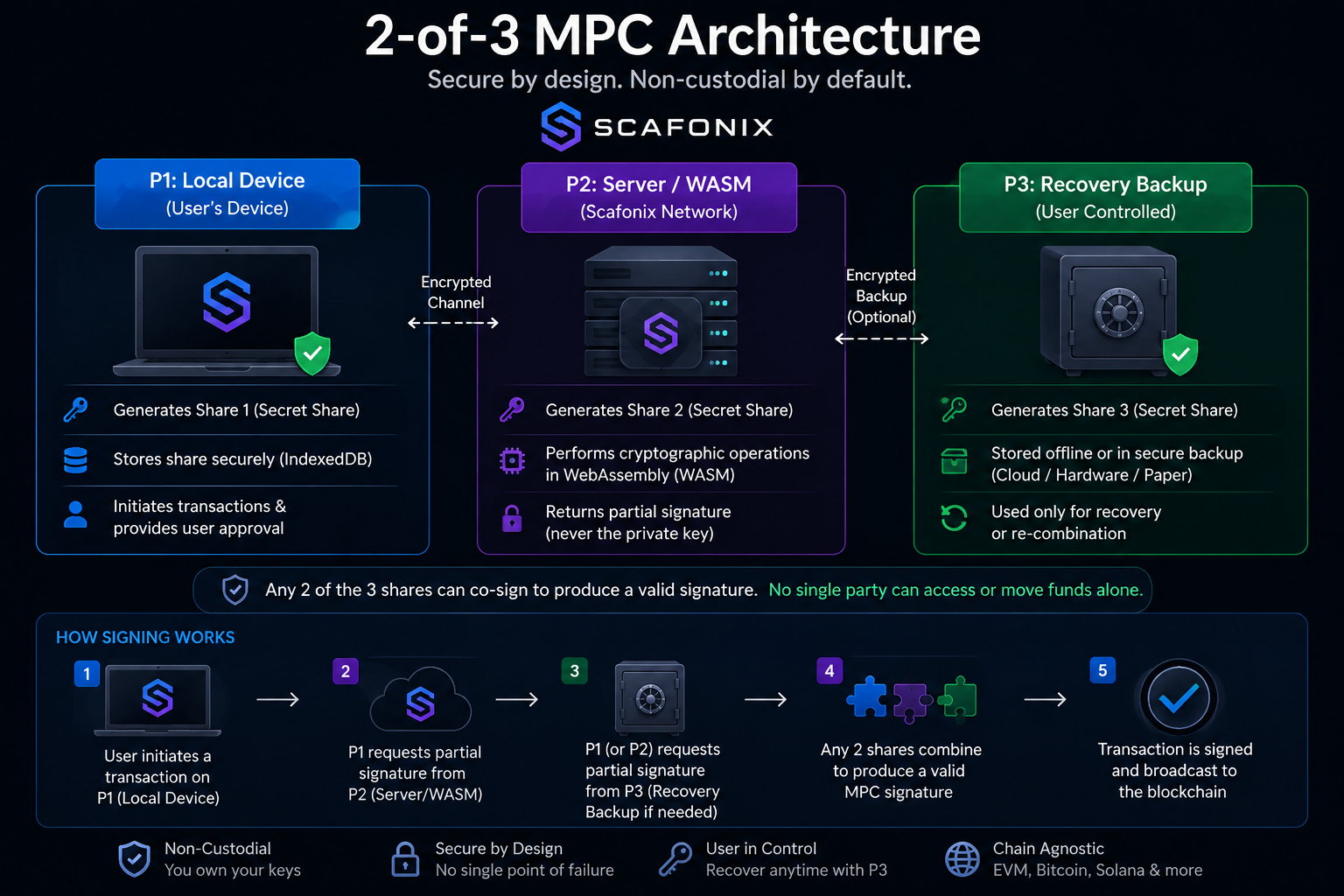
The core of Scafonix is a 2-of-3 threshold cryptography architecture. Instead of storing one complete private key in a single location, the wallet uses three independent shares:
• P1: the local device share
• P2: a deterministically derived share generated on demand inside the client-side WebAssembly environment
• P3: the user’s recovery backup share
Any two shares can participate in signing. Scafonix states that no complete private-key share is stored in a server database. Its zero-assembly model means the full private key is not reconstructed in memory during signing. This is designed to reduce the risk associated with exposing a complete private key to the application or a centralized wallet server.
React Integration Walkthrough
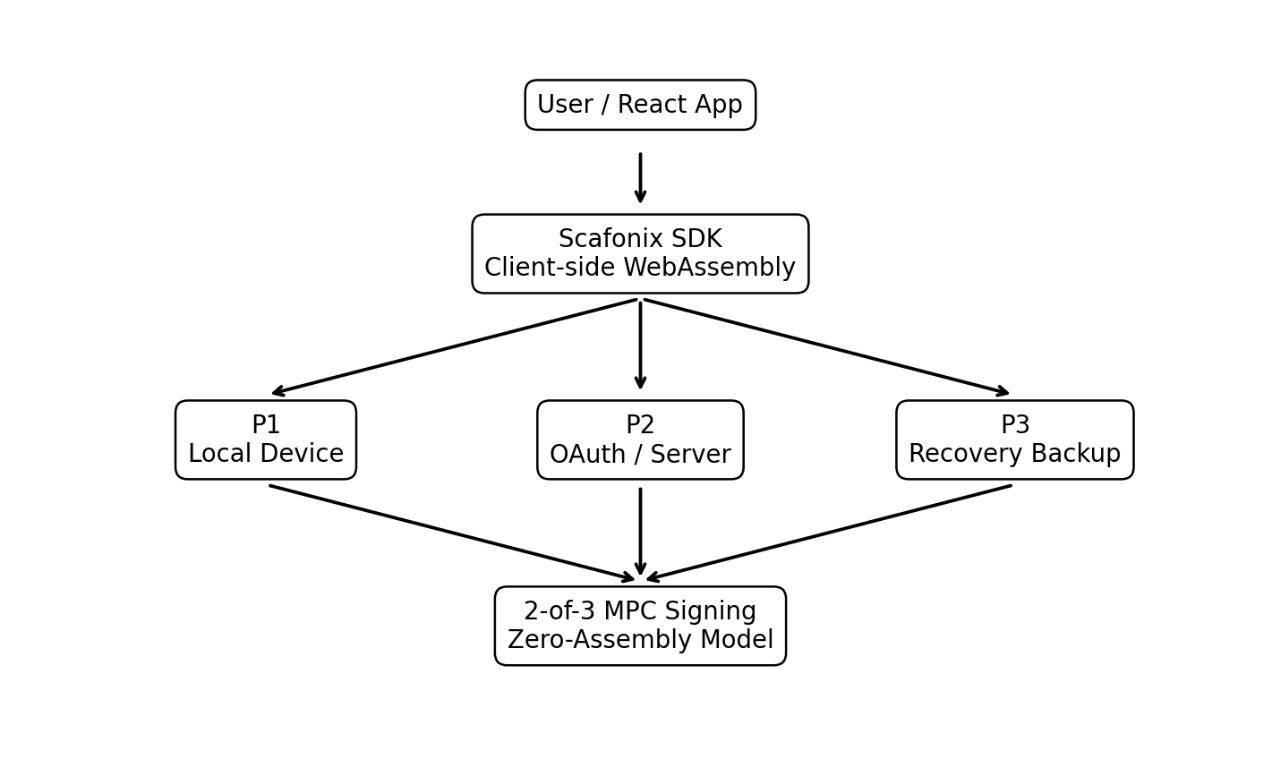
The integration starts by loading the SDK and waiting for it to become available. Scafonix recommends running SDK calls inside the Scafonix.onReady callback.
After initialization, the application can map an authenticated user to an embedded wallet:
console.log(wallet.address);
```
The userId should remain immutable for the lifetime of the account because Scafonix uses it when deriving the deterministic P2 share. Changing the format later can result in a different wallet identity.
Developers can derive addresses for supported networks using the wallet object:
Scafonix supports EVM as well as networks such as Bitcoin, XRP, Cosmos-based chains, Solana, and Tron, with additional Bitcoin-like and Cosmos-like chains available through custom chain registration.
For signing, developers can provide a transaction object or transaction hash depending on the blockchain:
For React applications, the dedicated @scafonix/react package exposes the useScafonixWallet hook, allowing wallet state and actions such as connecting, syncing, signing, backup, and export to fit naturally into React components.
Recovery, Multi-Chain Support, and Testing
A production wallet also needs a recovery path. Scafonix provides wallet synchronization through syncWallet(userId). Developers can call it during sign-in or page initialization. If local browser storage has been wiped or a user moves to another device, the recovery flow can request the user’s backup credentials.
Applications should also expose an accessible backup or export option in their account or settings UI. Developers can use showBackupModal(userId) to let users manage their recovery share. Scafonix specifically warns that clearWallet() should not be used for normal application logout because it purges the local P1 device share and can force the user into wallet recovery on the next login.
Scafonix is designed for multi-chain applications. Built-in address formats include ETH/EVM, BTC, XRP, COSMOS, SOL, and TRX, while Cosmos-style networks can be addressed through their human-readable prefixes. Developers can also register supported custom Bitcoin-like or Cosmos-like chains before requesting an address.
Security Considerations
For wallet infrastructure, security is not simply about hiding a private key. Scafonix describes several protections around its client-side signing environment, including zero-assembly signature generation, multiplicative blinding, deterministic RFC 6979 nonces, and volatile-memory wiping inside the WebAssembly environment.
The SDK documentation also recommends normal application-level error handling. Authentication cancellations, verification failures, backup problems, or password mismatches should be caught and handled with useful feedback rather than allowing the application to fail silently.
Localhost vs. Production
Testing is straightforward during development. When Scafonix detects local origins such as localhost, 127.0.0.1, or file://, it automatically enters Mock Mode and returns simulated wallet addresses and instant signatures. This allows developers to test the integration without performing live wallet operations.
For a production deployment, developers should use an HTTPS-enabled domain and follow the SDK’s domain and API-key configuration requirements.
Scafonix vs. Privy
Scafonix and Privy both aim to simplify embedded wallet experiences, but their architectural emphasis is different. Scafonix focuses on client-side WebAssembly, distributed key shares, and zero-assembly signing. Its model is designed to avoid keeping a complete private key in a centralized server database.
For developers, the important consideration is the security and infrastructure model behind the wallet. Teams that want a client-side, non-custodial architecture with distributed signing may find Scafonix particularly relevant, while teams should evaluate each provider against their own security, recovery, authentication, and infrastructure requirements.
Conclusion
Scafonix provides developers with embedded wallet infrastructure built around threshold MPC, client-side WebAssembly, social-login-based onboarding, and multi-chain signing. Its 2-of-3 architecture provides recovery flexibility while its zero-assembly approach is designed to keep the complete private key from being reconstructed during normal signing.
For React developers, the workflow is straightforward: initialize the SDK, connect an authenticated user, derive addresses, provide a clear backup path, and request signatures when transactions need to be authorized. With Mock Mode available for local development, teams can also build and test the integration before moving to an HTTPS production environment.
References
Official Scafonix documentation: https://www.scafonix.com/docs
Technical specification and AI context: www.scafonix.com
Prepared by Isaac